Stop saying "leverage" — 12 weak verbs killing your pitch
8 May 2026 · 5 min read
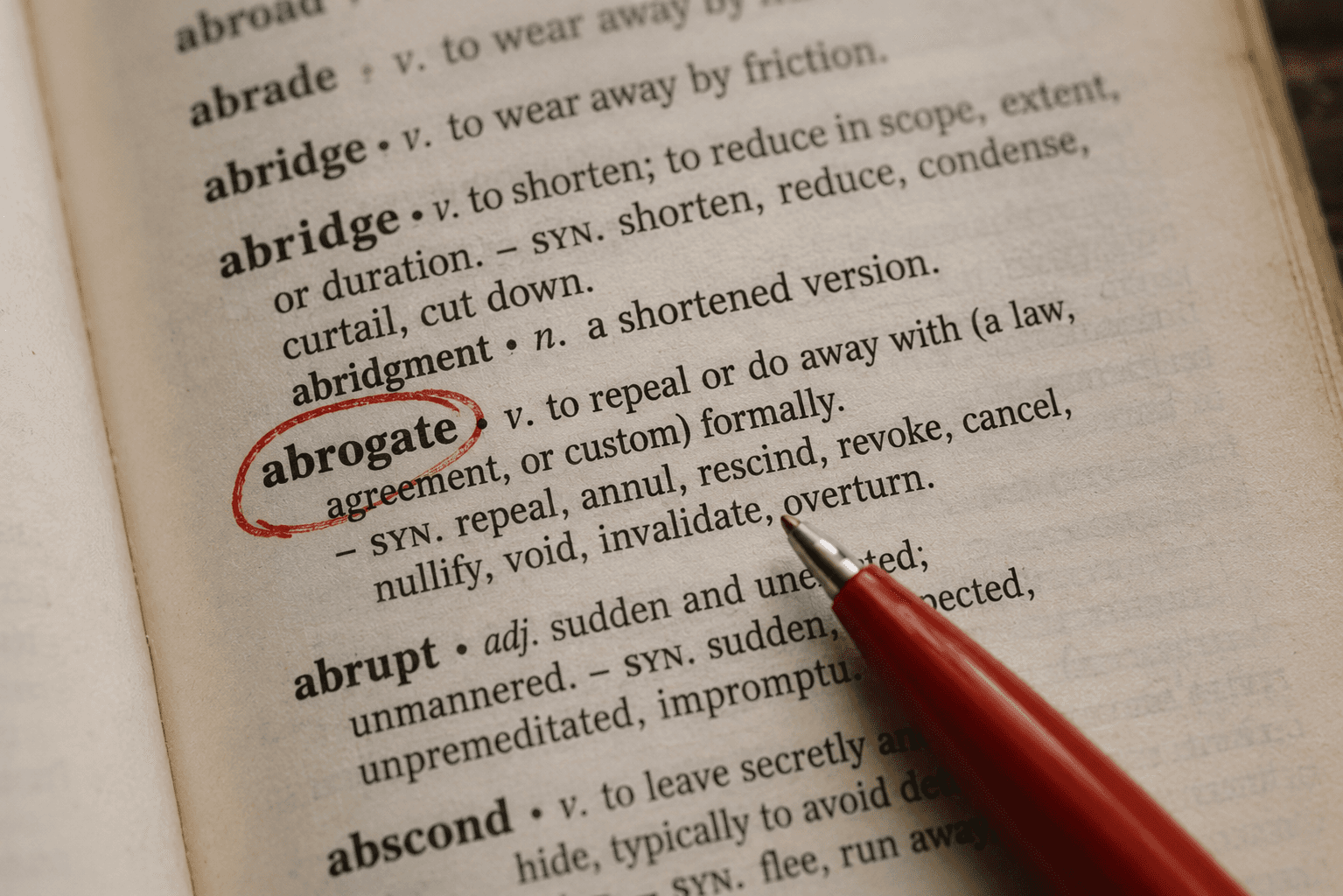
I'm going to ruin twelve words for you.
You won't be able to write them again without flinching. Good. That's the point. You shouldn't have been writing them in the first place.
These twelve verbs show up in 80% of decks I read. They make the writer feel professional. They make the reader's eyes glaze. They are wallpaper for the corporate brain — neutral, unobjectionable, instantly forgettable.
Cut them all. Today. Use the alternatives below.
The hand-gesture test
Here's how I screen verbs in fifteen seconds.
Read the verb out loud. Try to mime it with your hand. If you can — crush, cut, slash, pinpoint — keep it. Your brain knows what it looks like.
If you can't — leverage, enable, facilitate — it's vapor. You can't picture it because there's nothing to picture.
The test has been right for twenty years. I'm not going to start being polite about it now.
The twelve
1. leverage
Killed by overuse around 2014. Still shambling around your slide deck. There is no situation where "leverage" is the right verb. None.
❌ "We leverage AI to enable better outcomes."
✅ "We use AI to cut sales-cycle length by 40%."
Try: use, deploy, run on. All clearer. All shorter.
2. optimize
A polite way of saying "make better" without committing to anything. What got better? By how much? When?
❌ "Optimize your workflow."
✅ "Cut your workflow from twelve steps to four."
Try: cut, slash, shorten, speed up. Specifics or nothing.
3. enable
The word weak founders reach for when they want their product to sound systemic.
❌ "Our platform enables teams to ship faster."
✅ "Our platform lets teams ship 2x faster."
Try: let, unlock, free up, unleash. Three of those four are also gesturable. Bonus.
4. empower
Soaked in 2019 corporate-handbook smell. Your product doesn't empower anyone. It hands them tools. It gives them control. It removes blockers. Be specific about which.
❌ "Empowers managers to make data-driven decisions."
✅ "Hands managers the three numbers that matter."
Try: hand, give, equip.
5. enhance
Means absolutely nothing. Could go anywhere. That's why writers love it. That's why readers ignore it.
❌ "Enhances customer experience."
✅ "Cuts support tickets by 30%."
Try: sharpen, boost, sync, speed up. If you can't quantify the enhancement, it isn't one.
6. facilitate
A four-syllable word for "help." Why are we using it.
❌ "Facilitates cross-team collaboration."
✅ "Bridges product and sales in one channel."
Try: run, host, bridge, sync. All shorter. All more specific.
7. transform
Reserved for prophets, not products. If your product transforms anything, prove it with a number, or stop saying it.
❌ "Transforms how teams build software."
✅ "Cuts time-to-deploy from days to minutes."
Try: rebuild, flip, rip apart, crush. Verbs with edges.
8. allow
Soggy. Permission-granting. Your product doesn't allow people to do things — it gets out of their way. There's a difference.
❌ "Allows you to send notifications."
✅ "You send notifications in one click."
Half the time you can just remove the verb entirely.
9. assist
A bureaucrat's word. It hedges. It softens. It says "we don't really know what we do, but we'll be near you while you do it."
❌ "Assists sales teams in closing deals."
✅ "Closes 23% more deals for sales teams."
Try: help, run, drive, ship, close. Pick the one that's actually true.
10. benefit
So vague it hurts. What's the benefit? When does the user feel it? In dollars or in hours?
❌ "Customers benefit from real-time insights."
✅ "Customers spot revenue leaks within minutes."
Try: save, win, gain — and pair every one with a number.
11. address
The corporate dodge. It says "we acknowledge this exists" without committing to fixing it. If your product addresses something, you're being modest. Or evasive. Either way, you're losing the reader.
❌ "Addresses common compliance challenges."
✅ "Kills 90% of compliance escalations."
Try: fix, kill, tackle, solve.
12. analyze
The most dangerous one because it sounds technical. It isn't. Every B2B tool on earth claims to analyze something. The differentiator is what your product finds.
❌ "Analyzes customer behavior."
✅ "Spots which customers will churn this quarter."
Try: spot, surface, pinpoint, expose, flag. Show me the verb of the discovery, not the action of looking.
What they all have in common
Every dead verb on this list shares one thing: it describes a category of activity, not a specific action.
Leverage could mean anything. Cut is one thing. The category is the corporate fog. The specific is the differentiator. Always.
Open your last deck. Search for these twelve. Count the hits. I'd bet money you have at least four of them in your value prop alone.
Homework
Three steps. Ten minutes. Do them now.
One. Open your latest deck or one-pager. Cmd-F. Search for each of the twelve.
Two. For every hit, ask: what's the specific verb underneath? What does my product actually do that I'm hiding behind a verb a hundred competitors also use? Replace with that.
Three. Read the new version out loud. If you stumbled less, you've already won.
If you can't find a specific replacement — if the activity underneath is genuinely vague — that's not a writing problem. That's a positioning problem. Different essay. We'll get there.
Stop hiding behind verbs
Every dead verb is a place where you almost said something interesting and chickened out. The fix isn't more vocabulary. It's more nerve.
Cut the twelve. Replace with verbs your hands can mime. Watch your prose pick up a heartbeat.
Want feedback on your own messaging? See an example →